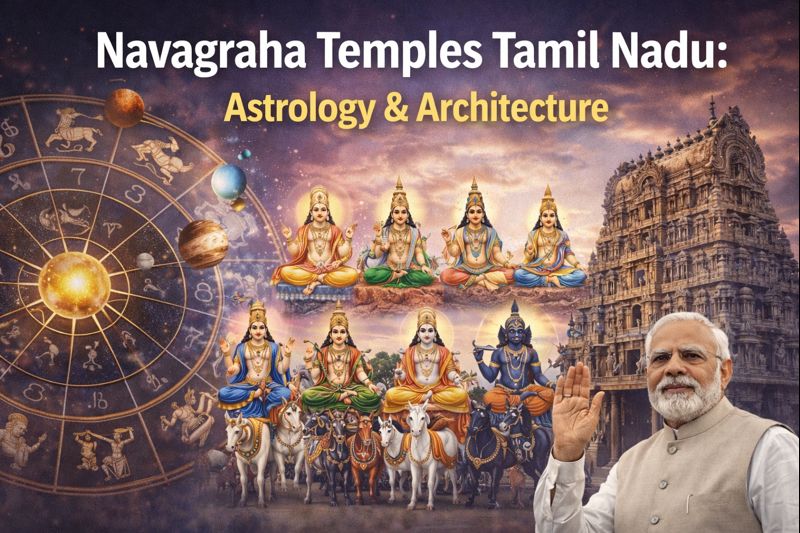
Nestled in the Thanjavur and Nagapattanam districts of Tamil Nadu, the Navagraha temples form a unique religious circuit. Dedicated to the nine celestial planets that are believed to influence human lives and destinies, these temples offer more than just spiritual solace—they are a testament to ancient Dravidian architecture and the human desire to understand our place in the cosmos.
Rise of Spiritual Tourism in India
India’s spiritual tourism sector has grown exponentially in recent years. A 2024 report by the India Brand Equity Foundation revealed that visitors engaged in religious tourism rose from 677 million in 2021 to 1,439 million in 2022, generating revenues of US$16.2 billion. Projections suggest that by 2030, over 100 million people will be employed in spiritual tourism, which is expected to reach US$59 billion by 2028.
Despite the commercialization of faith in many popular sites like Varanasi and Ayodhya, the Navagraha temples stand out for their restraint and focus on astrology rather than spectacle.
Historical and Architectural Significance
Built in the Dravidian architectural style, most Navagraha temples date back to the Medieval Chola period (9th–11th century CE). They are primarily Shiva temples, each associated with a specific celestial ‘graha’ or planet, except Suryanar Kovil, which is dedicated to the Sun God.
According to historians:
-
George Michell: “The Hindu temple is a microcosm of the universe, with the sanctum representing the centre of creation.”
-
Subhash Kak: The Navagraha temples represent the outer and inner cosmos, with layouts reflecting celestial cycles.
-
Adam Hardy: Chola temples demonstrate axiality, proportion, and advanced engineering, blending symbolism with architecture.
Visiting the Navagraha Circuit
Starting at Suryanar Kovil, about 15 km from Kumbakonam, the temple showcases classic Dravidian features:
-
Walled courtyard
-
Compact mandapa (pillared hall)
-
Garbagraha (inner sanctum)
All nine planets are represented, with Surya at the center. The temple’s stucco deities, vibrant pillars, and ornate vimana reflect meticulous planning and devotion.
From there, the journey continues across the circuit:
-
Thingalur: Kailasanathar Temple, dedicated to Chandra (Moon), with a reflective temple tank, Chandrapushkarani.
-
Vaitheeswaran Kovil: Mars (Angaraka) shrine, known for healing rituals.
-
Thiruvenkadu: Mercury (Buddha) sthalam, showcasing late-Chola Dravidian artistry.
-
Alangudi: Jupiter (Guru) sthalam, emphasizing wisdom and guidance.
-
Kanjanur: Venus (Shukra) sthalam, focusing on balance and harmony.
-
Thirunallar: Saturn (Shani) sthalam, expansive with mandapas and Nala Theertham temple tank.
-
Thirunageswaram: Rahu shrine, part of Naganathaswamy Temple, known for the blue abhishekam milk ritual.
-
Keezhaperumpallam: Ketu sthalam, modest and austere, reflecting detachment and release.
A Spiritual Yet Secular Experience
While I approached the Navagraha temples as a skeptic, the architecture, rituals, and devotion created an undeniable impact. The temples honor pattern and astrology, offering a framework for understanding life rather than demanding faith.
As my guide Shiva explained, “You don’t need to believe in planets to respect what these temples do for people. They provide courage and clarity. That itself is divine.”
The quiet devotion of pilgrims—lighting oil lamps, performing rituals, and walking through painted corridors—revealed the human search for pattern and meaning in an indifferent universe.
Legacy and Cultural Impact
The Navagraha temples remain an enduring testament to:
-
Ancient Chola architecture
-
Astrological and ritualistic significance
-
Cultural preservation amidst modern spiritual tourism
Even today, in a country where faith is increasingly commercialized, these temples provide a unique blend of secular curiosity and spiritual tradition, reminding visitors of the delicate balance between devotion, culture, and history.